Qualify Without Interrogating
1.2.2026
Qualify Without Interrogating
If your booth team can’t qualify fast, you don’t have a lead problem — you have a time leak.
The booth trap nobody talks about
Most booth teams do one of two things:
- Interrogate people like it’s a police report: "Budget? Authority? Timeline?"
- Avoid qualifying entirely and burn 10–15 minutes with someone who was never buying anything.
Both cost you money.
Trade shows don’t punish you for bad qualification in the moment. They punish you later — when your follow-up list is bloated, your reps lose trust in the leads, and the real buyers slip through the cracks.
Your team is trying to be polite and accidentally being inefficient.
And the fix is not more questions. It's better questions, asked the right way.
Qualification isn't a checklist. It's a conversation.
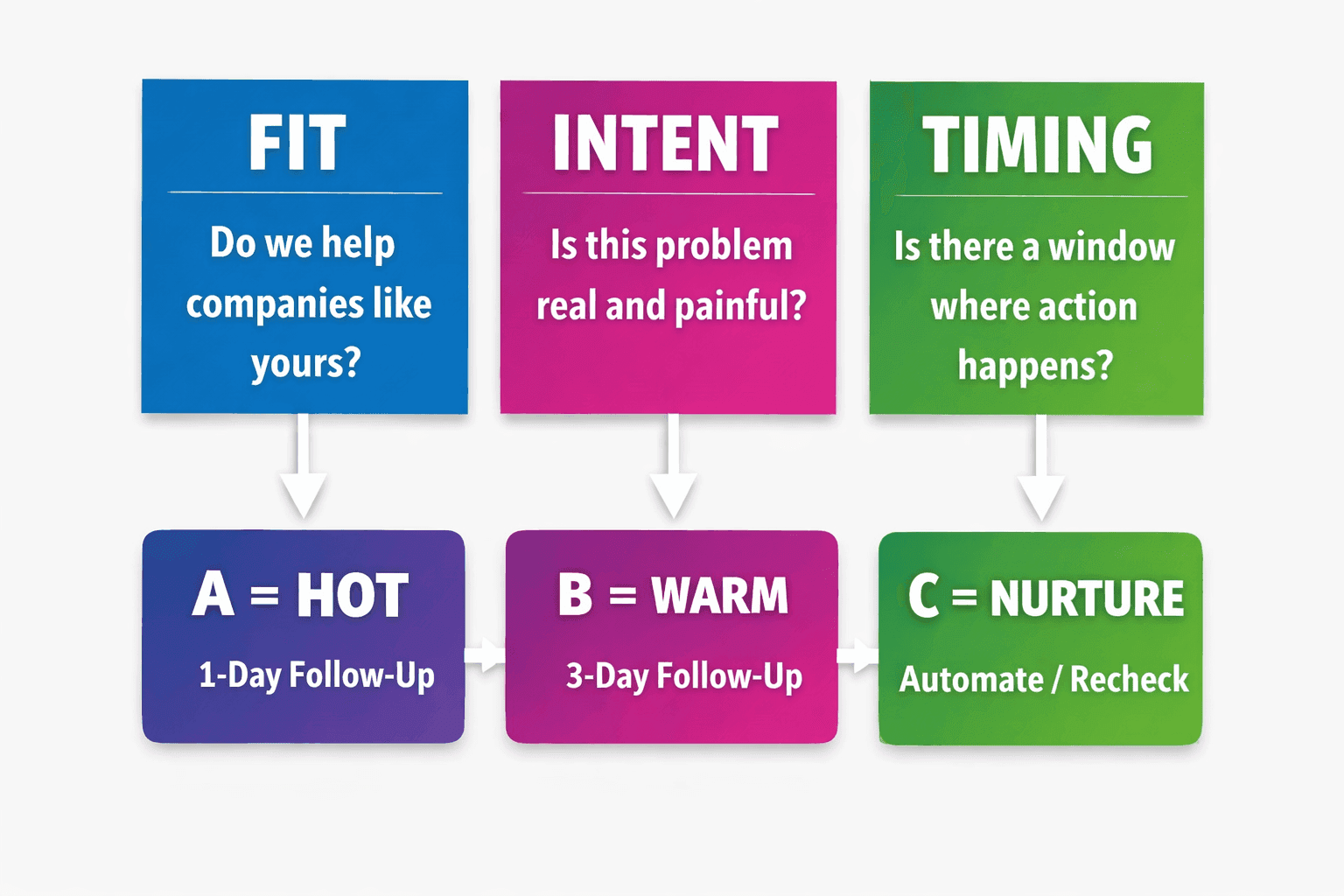
Great booth qualification discovers three things without making the visitor feel trapped:
Fit
Do we help companies like yours?
Intent
Is this problem real (and painful), or just curiosity?
Timing
Is there a window where action actually happens?
If you can learn those three things, you can prioritize follow-up and stop treating every badge scan like revenue.
The secret move is permission
Most teams skip this.
They either launch into questions with no context, or they avoid questions entirely because they don't want to be "salesy."
Permission fixes both.
Use one opener every time:
"Quick question so I can point you the right way — fair?"
That one sentence does three things instantly:
- It shows respect.
- It frames your questions as helpful (not invasive).
- It makes the visitor more likely to answer honestly.
The 3-line booth script
Once you have permission, run this sequence in order:
- "What's prompting you to look at this now?" (Intent)
- "What are you using today?" (Fit)
- "When you say 'soon,' is that 30 days, 90 days, or later?" (Timing)
That's not interrogation. That's helpful triage.
Why this works when "BANT at the booth" fails
Old-school qualification sounds fine until you say it out loud to a stranger.
- "Budget" can feel like you're reaching into their wallet.
- "Authority" can feel like you're challenging their status.
- "Timeline" often gets a vague answer because "someday" is safer than "never."
Fit / Intent / Timing maps to how buyers actually think:
- "Is this for me?"
- "Is this worth solving?"
- "Is this happening now or later?"
And it gives your team one job: route the lead correctly.
Route follow-up based on what you learn (A / B / C)
Qualification without routing is just trivia.
A simple booth routing system:
- A = Hot (fit + real pain + near-term timing)
- B = Warm (fit + interest + mid-term timing)
- C = Nurture (not ready, not fit, or long-term)
This prevents the most common post-show failure: treating every lead the same and then wondering why follow-up feels like a grind.
PURPLE RULE
PURPLE RULE: Qualification done well feels helpful, not invasive.
Purple Quick Hits
-
The Point: Qualification should feel helpful, not invasive.
-
What Most People Do: Interrogate visitors or avoid qualifying entirely.
-
What Works Instead:
- Ask permission for a quick question.
- Use Fit / Intent / Timing conversationally (in that order).
- Route follow-up based on what you learn (A / B / C).
-
Do This Tomorrow:
- Train one permission phrase (everyone uses the same opener).
- Add timing bands to lead capture: Now / 30 / 90 / Later.
- Define routing rules: A = hot, B = warm, C = nurture.
-
Template/Tool: Subscribe to our insights and I'll share the Booth A/B/C routing template: https://www.tradeshowsavvy.com/insights
-
Purple Rule (repeat): Qualification done well feels helpful, not invasive.