Your Booth Isn't a Billboard. It's a Belonging Test.
27.2.2026
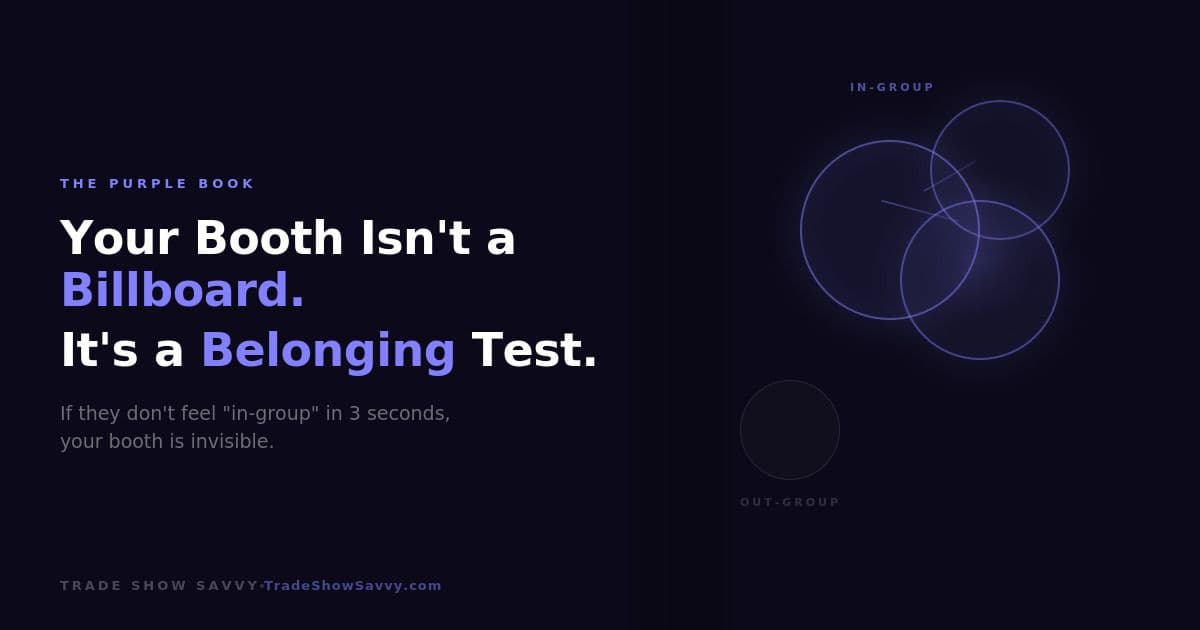
Your Booth Isn't a Billboard. It's a Belonging Test.
If they feel "out of group," your booth can be 40x40 and still invisible.
"Those aren't my people."
That's the decision your prospect made in 3 seconds. Your 40x40 booth never had a chance.
Not because of the lighting. Not because of the graphics. Not because of the staff. It was something older than marketing — something their brain decided without a single conscious thought.
Here's what nobody talks about at exhibitor kickoffs: your booth isn't competing with the booth across the aisle. It's competing with your prospect's nervous system — a system that's been sorting "us" from "them" since before language existed.
The Neuroscience of "My People"
Prospects don't walk up asking, "Is this a good solution?"
Their nervous system asks something faster: Are these my people… or not?
Research on oxytocin — often called the "bonding hormone," though it's more complicated than that — shows a consistent pattern. It amplifies warmth, trust, and cooperation toward the in-group. The people who feel familiar. Similar. Safe.
Not the people with the biggest banner. Not the people with the best swag. The people who feel like us.
And that's the game most exhibitors lose before the doors even open.
They build for everyone. Which quietly signals they're for no one.
Belonging Isn't Built with Taglines
"In-group" isn't created by clever copy or a well-designed logo wall. It's created by signals — fast, subconscious, and surprisingly specific:
Shared language. The words your buyer uses when they're talking to peers, not when they're reading your marketing site. If your booth says "integrated workflow optimization," but they say "I just need to stop losing leads after the show," you've already lost them.
Shared enemies. Every group bonds over friction. "We're all sick of…" is one of the most powerful belonging cues on the planet. If your booth names the frustration your buyer lives with daily, they slow down. If your booth speaks in generalities, they keep walking.
Shared rituals. How you start a conversation, how you demo, how you hand off to the next step — these micro-interactions signal whether someone belongs. Think about it: when you walk into a room where everyone already knows each other, you can feel it. Your booth creates the same feeling, for better or worse.
Shared identity markers. Roles, titles, vertical cues, outcomes. "For event marketers" is a belonging signal. "For innovative enterprises" is wallpaper.
Shared story. "People like us do it this way." When your booth tells a story your prospect already believes about themselves, the decision to engage isn't rational. It's reflexive.
When these signals are missing, your prospect has to work to decode you. And when the brain has to work, it walks.
The 3-Second Aisle Test
Stand ten feet from your booth. Squint. Can you tell who it's for without reading a paragraph?
If the answer is no, you're failing the aisle test — and most exhibitors are. Here's the pattern that keeps repeating: companies build booths that describe what they do instead of signaling who they're for. The difference matters because "what we do" requires reading and processing. "Who we're for" is a visual and emotional decision that happens before the conscious brain even engages.
Your hero message should start with them, not you. If the first words on your booth are "Leading provider of..." you've already told your prospect this is about you, not about them. Flip it. Start with the role, the pain, the moment they're living in right now.
And while you're at it, audit your booth for what I call "everyone words" — innovative, integrated, seamless, end-to-end, solutions. These words mean everything to your marketing team and nothing to a buyer scanning the aisle at 3 miles per hour. Kill them.
Your Opener Is a Membership Card
Most booth staff open with some version of "Hi, how are you?" or "So, what do you do?" Both of these put the burden on the prospect. They have to figure out whether this conversation is worth their time — and the default answer is always no.
Instead, open with a membership question. Something that confirms identity in ten seconds or less:
"Quick check — are you responsible for X or Y at your events?"
"Are you here trying to solve this pain… or prevent it from happening again?"
"What's the one thing that always breaks down between lead capture and follow-up for you?"
These aren't sales questions. They're belonging questions. They tell the prospect: we know who you are, we know what you deal with, and we built this for you. If the answer is yes, you're in. If the answer is no, you've saved both of you time — which is its own kind of respect.
Staff Signals: People Are the Booth
Your graphics can say all the right things, but if your staff is huddled in a circle checking their phones, the real message is: you're interrupting us.
Staff posture, attire, and behavior are belonging signals whether you design them to be or not. Open stance, eye contact, and an approachable position near the aisle say "safe." Arms crossed, backs turned, and a cluster of staffers deep in conversation say "closed."
Everyone on your team should be able to say the same one-sentence "who it's for" line. Everyone should be able to tell the same 30-second proof story — one customer, one outcome, no jargon. If your team can't do both of those things cold, you have a training problem, not a booth design problem.
Micro-Rituals That Create Belonging
Every strong community has rituals. Your booth should too.
A welcome ritual — how you greet, where you stand, what you offer in the first five seconds. A demo ritual — one to two minutes, one path, one payoff. Not a feature tour. A story with an ending. A handoff ritual — scan, next step, calendar or follow-up promise. No ambiguity. A closing ritual — "Here's what happens next…" in plain language.
When these rituals are consistent, your booth stops feeling like a series of random conversations and starts feeling like a place. People remember places. They don't remember pitches.
The Red Flags That Signal "Out-Group"
If you're doing any of these, you're actively pushing prospects away:
Talking to each other while prospects walk by. This is the number one killer. It signals "you're interrupting," and most people won't interrupt. Asking "So what do you do?" before earning the right. This feels cold and transactional. Over-explaining products before confirming fit. Cognitive load equals exit. Generic giveaways with no identity tie. A branded pen doesn't make someone feel like they belong. Cluttered walls and too many offers. Confusion reads as risk. When the brain can't quickly parse what you're about, it defaults to the safest decision: keep walking.
The Follow-Up That Keeps Them In-Group
The belonging signal doesn't end when the show closes. It either continues or it collapses.
Your follow-up email should start with their words from the booth — not your template. The first line should confirm identity: "For teams like yours who…" Send one relevant asset, not a link dump. Schedule the next step while you're still onsite whenever possible. Reference the shared enemy or shared win you discussed. If your follow-up feels generic, you've just told someone who felt "in-group" for a few minutes on the show floor that they were never really part of the group at all.
The Purple Rule
If your booth doesn't create in-group in 3 seconds, it creates out-group by default.
This isn't about being exclusionary. It's about being specific. The most welcoming thing you can do is tell someone — quickly and clearly — "this is for you." And the most alienating thing you can do is make them guess.
Do This Tomorrow
1. Write your aisle headline as: "For [ROLE] who are tired of [PAIN]…"
2. Replace your hero graphic with one bold sentence: "People like us measure success by ___."
3. Script your opener to confirm identity in 10 seconds: "Quick check — are you responsible for ___ or ___?"
Want the full In-Group Booth Signals Checklist? It covers all 10 areas — from identity lock and message architecture to staff signals, micro-rituals, and follow-up. Comment INGROUP or reach out and I'll send it your way.
5-Minute Team Huddle
Print this. Do it every morning on the show floor.
- Who is our #1 "people like us" today?
- What pain are they walking in with?
- What's the one proof story we're leading with?
- What's our one next step offer?
- What will we stop doing that signals out-group?