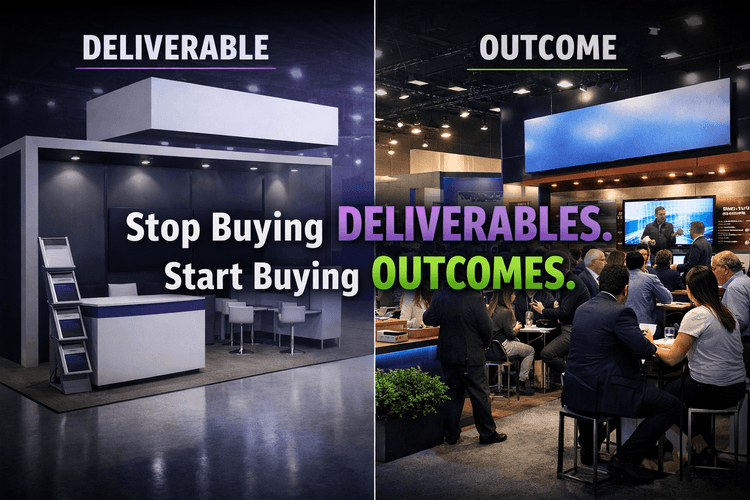
Stop Buying Deliverables. Buy Outcomes.
10.3.2026
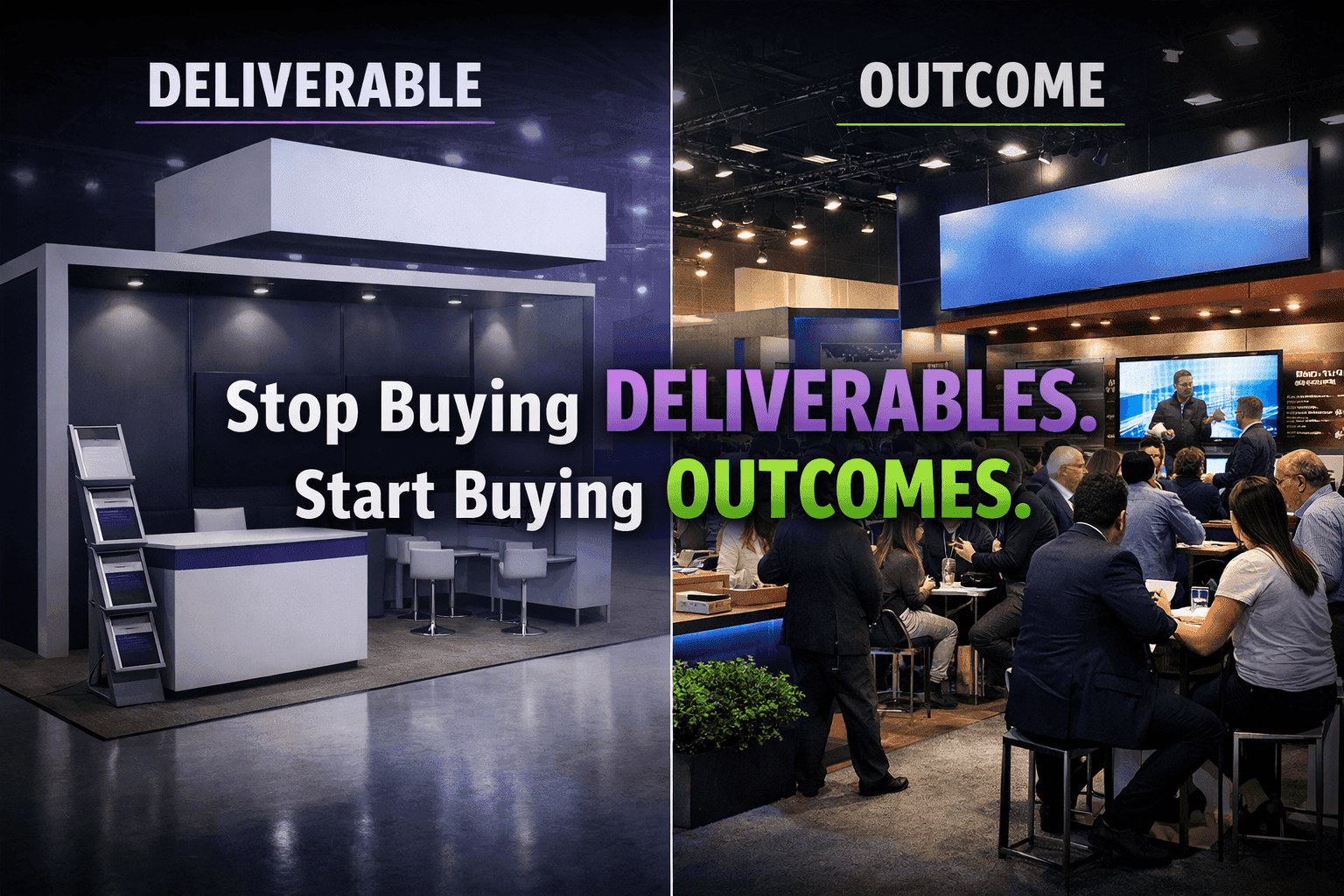
Stop Buying Deliverables. Buy Outcomes.
If your vendor scope is built around stuff, do not act surprised when you get stuff instead of results.
Most trade show teams buy deliverables because deliverables are easy to see, easy to price, and easy to approve.
A booth rendering is easy to review. A graphic package is easy to count. A demo screen is easy to request. A lead scanner plan is easy to assign. A giveaway order is easy to check off.
That is exactly why this goes wrong.
Because none of those things are the outcome.
A booth is a deliverable. A conversion system is an outcome.
That distinction matters more than most teams realize.

The Real Problem
When companies buy deliverables, they usually end up managing vendors asset by asset instead of performance by performance.
Did the booth get built? Did the graphics get printed? Did the counters arrive? Did the monitors work? Did the furniture show up on time?
Those are fair operational questions.
They are just not the strategic question.
The strategic question is this:
Did the booth create the conditions for the result you wanted?
Did it help your team start more quality conversations? Did it make your proof visible fast enough from the aisle? Did it move the right people into demos, meetings, and follow-up? Did it reduce friction for your staff instead of creating it? Did it create something reusable after the show, or did it die on the floor with the carpet?
A lot of trade show programs fail right here.
Not because the team is lazy. Not because the vendors are incompetent.
Because the buying language was wrong from the beginning.
The scope was written around deliverables.
So the vendors delivered deliverables.
Why Deliverables Feel Safer
Deliverables feel concrete.
Outcomes feel harder.
A vendor can promise booth graphics. A vendor can promise installation. A vendor can promise furniture, shelving, counters, and hanging signs.
But outcomes force a harder conversation.
What is this booth supposed to do?
Not in vague language. In operating language.
Is the goal more booked meetings? Better live demos? Higher conversion from traffic to conversation? Cleaner traffic flow? More visible proof? Fewer on-site surprises? More reuse across multiple shows?
Now you are no longer buying parts.
You are buying performance support.
That changes the scope. That changes the review process. That changes what “done” means.
A Booth Should Be a System
A booth should not be treated like a pile of assets.
It should be treated like a system.
A system has a job.
At a trade show, that job usually includes four things:
- meetings
- conversions
- operational reliability
- reuse
If your scope does not connect to those four things, it is probably too focused on stuff and not focused enough on results.

1. Meetings
Can the booth support the number and quality of conversations you want?
Not just visually. Operationally.
Do you have the right spaces for quick conversations, deeper demos, private meetings, and scheduled appointments? Can sales reps move prospects through the space without creating a traffic jam? Can someone walk up and understand where to go next?
If the answer is no, the booth may still be beautiful.
It is just not doing its job.
2. Conversions
Attention is not the same as progress.
A crowded booth can still underperform if there is no path from curiosity to commitment.
What turns a passerby into a conversation? What turns a conversation into a demo? What turns a demo into a booked next step?
If your scope says “install touchscreen demo station,” that is a deliverable.
If your scope says “support self-selection, proof, and guided next-step conversion,” that is an outcome-driven requirement.
That is a much smarter way to buy.
3. Operational Reliability
Trade show teams lose a shocking amount of performance to preventable chaos.
Late graphics. Confusing setup. Missing storage. Bad cable management. No room for team materials. No clear traffic flow. No easy way to reset after a conversation. A demo setup that works in theory and fails under show-floor pressure.
Operational reliability is an outcome.
A booth that looks good in a render but creates on-site friction is not a successful booth.
It is an expensive problem wearing nice clothes.
4. Reuse
The smartest event teams do not buy one-time artifacts every time.
They buy components, structures, messaging systems, and assets that can be reused, reconfigured, or repurposed across the next show, the next campaign, and the next sales cycle.
Reuse is not just a budgeting issue.
It is an outcome issue.
A booth that dies after one event may still count as delivered. A booth system that keeps creating value after the show is what mature teams are actually after.
What Outcome-Based Buying Looks Like
This does not mean every vendor agreement suddenly becomes pay-for-performance.
That is not always realistic.
But it does mean the scope should connect the work to business intent.
Instead of this:
- Design booth graphics
- Build demo counter
- Deliver literature rack
- Install monitor wall
Start with this:
- Support 12 scheduled meetings per day without crowding
- Make proof visible within 3 seconds from the aisle
- Create a clear path from attraction to demo to next step
- Reduce setup-day surprises with milestone reviews and acceptance criteria
- Maximize reuse across the next 3 events
Now the deliverables still exist.
But they exist in service of the outcome.
That is the difference.
The Hidden Cost of Buying Deliverables
When teams buy deliverables, they often get trapped in late-stage disappointment.
Everything looked fine in planning.
The render looked great. The estimate looked reasonable. The timeline seemed under control. The assets were approved.
Then the show happens.
The booth is complete, but the traffic flow is awkward. The messaging is technically correct, but weak from the aisle. The demo area backs up. The staff has nowhere to reset. The proof is buried. The meetings happen, but the booth does not help move them forward.
Then everyone says the same thing:
We need better results next time.
Usually what they really need is better buying language next time.
Because the problem started long before the show floor.
The Simple Upgrade
Before you approve the next vendor scope, translate it into outcomes.
Do not ask only, “What are we getting?”
Ask, “What is this supposed to produce?”
That one shift improves almost everything downstream:
- better decisions
- better accountability
- better milestone reviews
- fewer assumptions
- fewer emotional approvals
- fewer late-stage surprises
It also makes internal alignment easier.
Marketing wants brand consistency. Sales wants meetings. Leadership wants pipeline. Operations wants fewer fires.
Outcome language gives all of them something useful to evaluate.
Deliverables alone do not.
PURPLE RULE: If you buy deliverables, you’ll get deliverables—not results.
Purple Quick Hits
The Point: Deliverables are easy to count. Outcomes are what actually matter.
What Most People Do: They buy booth assets and then wonder why results are inconsistent.
What Works Instead:
- Define outcomes before you define scope
- Tie vendor work to measurable results or measurable outputs
- Use milestones and acceptance criteria to catch problems early
Do This Tomorrow:
- Rewrite every vendor scope as an outcome statement
- Add acceptance criteria using the phrase “done means…”
- Tie payments to milestones, not emotions
Purple Rule (repeat): If you buy deliverables, you’ll get deliverables—not results.