The Goal Is Momentum, Not Leads
12.3.2026
The Goal Is Momentum, Not Leads
If you're only counting new leads, you're ignoring the most valuable thing that happened at the show.
Every post-show report starts the same way: "We scanned 347 badges."
Great. How many of those turned into pipeline? How many were already in your CRM? How many were people who grabbed a stress ball and kept walking?
Here's the uncomfortable truth most trade show programs avoid: the biggest wins at your last show probably weren't new leads at all.
They were momentum.
A stalled deal that started moving again. A skeptical stakeholder who finally saw a demo in person and changed their mind. An evaluation that jumped two stages because your champion brought their boss to the booth. A competitor who got neutralized because your team had 20 minutes face-to-face with the economic buyer. A partner channel that locked in because the handshake happened in real life.
None of those show up in a badge scan report. But every one of them is worth more than a hundred cold leads.
The Lead Count Trap
The reason most programs obsess over lead counts is simple: leads are easy to measure. You scan a badge, you get a number. The number goes up. Everyone nods in the post-show meeting.
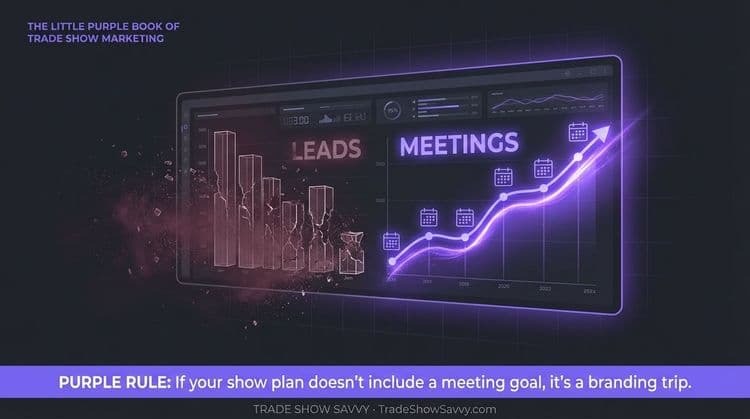
But lead count is a vanity metric dressed up as accountability. It tells you how many people stopped. It says nothing about what happened next.
The real question isn't "how many people did we meet?" It's "what moved forward because we showed up?"
That's momentum. And momentum is where the ROI actually lives.
What Momentum Looks Like
Momentum isn't abstract. It's specific and trackable — if you build the system to capture it.
Deal acceleration. An opportunity that was stuck at "evaluation" moved to "negotiation" because of a show conversation. That's not a new lead. That's revenue moving closer. If you're not tracking stage changes tied to show activity, you're missing your biggest wins.
Multi-threading. Your rep had one contact. Now they have three — including the VP who actually signs. That didn't show up as a "lead." It showed up as a deal that suddenly closed two months faster.
Competitive displacement. A prospect was leaning toward a competitor. Your team got 15 minutes at the booth, told a proof story that landed, and shifted the conversation. You'll never see this in a scan report. But you'll see it in the pipeline six weeks later.
Partner activation. A channel partner who'd been lukewarm for months shook hands with your GM, saw the new product live, and signed up for co-marketing. That meeting was worth more than every badge scan combined.
Stakeholder conversion. The CFO who kept blocking the deal walked through the booth, saw three customers on your proof wall, and asked your team for a follow-up meeting. That's not a lead. That's the deal.
How to Track It
You don't need a new platform. You need three habits.
Before the show: Pull a target list of 20 open opportunities and 10 strategic accounts. These aren't new leads you're hunting — they're existing deals you want to accelerate. Brief your booth team: "These are the accounts that matter. If anyone from these companies walks up, we escalate."
During the show: Add one field to your lead capture notes: "Opp advanced? Y/N." If the conversation moved something forward — a next step, a new contact, a shifted timeline — mark it. This takes five seconds and changes your entire post-show story.
After the show: Run a simple momentum report. Pull every opportunity that had a show interaction and compare: stage before the show vs. stage 30 days after. Time-to-close before the show vs. projected close after. New contacts added. Next steps booked. That delta is your real ROI — and it's a number your CFO will actually care about.
The Lie and the Truth
The lie: "We need more leads."
The truth: You probably have enough leads. What you need is for the deals you already have to move faster, close bigger, and stick longer. A trade show is one of the few places where that can happen in a single conversation.
When you stop measuring "how many?" and start measuring "how much moved?" — your program stops being a cost center and starts being a revenue engine.
PURPLE RULE
A trade show win is anything that makes revenue happen sooner.
Purple Quick Hits
- The Point: The most valuable show outcomes aren't new leads — they're existing deals that moved forward.
- What Most People Do: Count badge scans and report lead volume as the primary success metric.
- What Works Instead:
- Track deal acceleration: stage changes tied to show activity
- Measure multi-threading: new contacts added to existing opportunities
- Capture influence on open pipeline, not just net-new names
- Do This Tomorrow:
- Pull 20 open opportunities and 10 strategic accounts as your pre-show target list
- Add "Opp advanced? Y/N" to your lead capture form
- Run a 30-day stage-change report after the show and compare before vs. after
- Purple Rule: A trade show win is anything that makes revenue happen sooner.